Is Milk in Portugal Better?
Can changing your brand of milk help your pocketbook and give you less gas?

Got Milk?
What does this post’s title and the above sentence have to do with retirement or career change?
If you have suffered gas or bloating due to a dairy sensitivity or have lactose intolerance, you are certainly not looking forward to experiencing this for your retirement years. Or at any time for that matter. You likely have been looking for a solution to this issue most of your life.
What if I was to tell you that there might be a solution? And that it would require some travel.
One thing I can say from my time spent living and travelling in Europe is how much better I feel drinking the milk and dairy products that are available there. There is no question about it.
Whether it's having less bloat, no gas, to healthier and easier number twos, I have noticed a definite digestive system improvement when I drink milk in Europe.
This experience is not solely my own.
I am not lactose-intolerant and I will not extend my own personal experience to those who have to live with this condition. What I can say is that I often hear similar stories in my conversations with people that have moved to Europe from North America. The milk in Europe is easier on their digestive systems.
It’s not only the ease of digestion. The flavour of European dairy products and their lower cost are also cited by many expats as one of the benefits of living and travelling through Europe.
So again, why am I writing about milk in a Substack dedicated to retirement and career change?
The answer is that it is a symbol, a real and tangible one, for why people move to places in Europe in the first place. Politics aside, food quality and cost are key driving factors for people who have the means to move elsewhere.
In Canada, where I have lived much of my life, the dairy industry is tightly controlled through a milk supply management system that sets milk availability and prices. While there are a number of organizations involved, the net effect is that milk and dairy product prices are high for the consumer because the supply is controlled. The access that Canadians would have to international dairy products can be limited to some cheeses that you would find in specialty grocery stores.
The high cost of milk and milk products cannot be overemphasized. I think we have all felt the effects of inflation in the last few years where food items cost more for the same volume of product. Cream for your coffee and ice cream come to mind.
So where does this leave someone who is on a fixed income? Not in a strong position. In Canada, if you buy smaller units of milk, such as in one or two litre cartons, you will pay more than you would in a European country like Portugal.
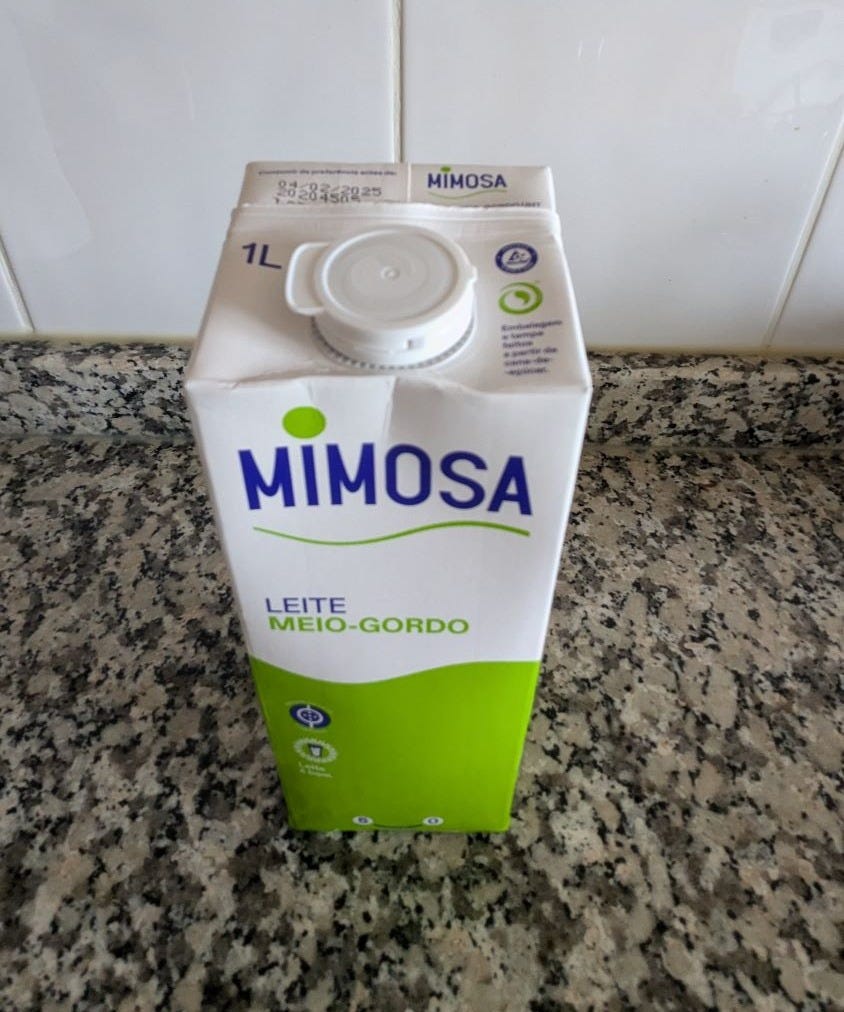
Cost. If you buy 1 or 2% milk in an individual one litre container in Portugal, the price is 0.99 Euros which is equivalent to approximately 1.50 Canadian dollars ($1.07 USD). The equivalent one litre carton purchased at a typical grocery store in Canada will cost you $2.99 CAD ($2.14 USD). So effectively in Canada you are paying double for the same product.
I can hear some readers saying “but what about the lower salaries in Portugal and how that relates to the price of food in the country?” Fair point.
Let’s take into consideration average salaries in Portugal and Canada. According to the OECD statistics for 2023 (adjusted to USD) the average salary in Canada is $66,211 and in Portugal $37,500. Based on this, the average Canadian salary is about 1.75 times the average salary in Portugal. Incorporating this factor into our milk comparison, the cost of a one litre carton of 1 or 2% milk in Canada should be $2.63 CAD to be comparable to the cost of the equivalent container in Portugal. It is not.
I will not see a one litre carton of milk in Canada for less than $2.99 CAD. Anywhere. And it is often more expensive than this.
Convenience. Mimosa Meio Gordo is a very common milk brand in Portugal. You can purchase it almost anywhere food items are sold. It typically comes in one litre containers or packs of 6 x 1L. Many shoppers often break open the packs and will take one or two cartons as opposed to the entire six-pack. You, as the consumer, decide how much you want to purchase.
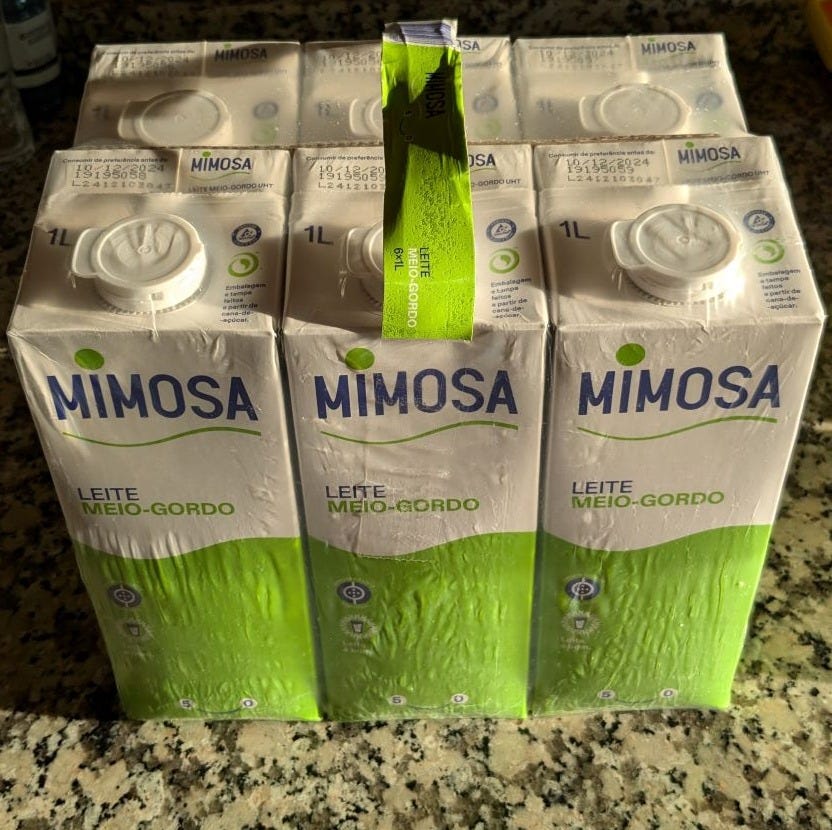
In Canada there is usually not a multi-pack choice at that size (only for smaller 200 or 250 mL sizes in packs of three). You typically have to buy a 1L carton one at a time.

There is one way around this.
You can purchase four litres of bagged or jug milk in Canada. The lowest price you will typically pay for this amount is $6.00 CAD ($4.29 USD). This would then be the same price (based on the current exchange rate) for four 1L cartons of milk purchased in Portugal. The drawback is that the bagged milk has to be consumed within its best before date. You can freeze it so it can last longer but I find milk that has been thawed after freezing to have a thinner taste than milk not frozen but consumed within its best before date.
There is one other aspect to that one litre carton of Portuguese milk that you typically will not find in North America. The Portuguese milk can last several months in the cupboard before you consume it.
UHT. Milk purchased in Portugal does not need to be put in the refrigerator until it is opened. Why is this?
European milk goes through Ultra High Temperature (UHT) treatment at ~284oC for ~three seconds eliminating virtually all bacteria and making it shelf-stable for about six months if it is left unopened.
This UHT treatment may also be helpful in reducing dairy sensitivity and lead to better digestive outcomes when processing milk.
For the Portuguese, the use of UHT Treatment and cartons came out of necessity. Years ago, many people in Portugal did not have large refrigerators and did not have electricity, so the use of tetra-packs and UHT was developed to increase the shelf-life of milk.
Digestive Benefits. I have noticed my digestive system functioning far better when consuming European dairy products than North American dairy products. When I arrive in Portugal I experience this effect relatively quickly, within one or two days. It’s a palpable positive feeling.
As someone who loves milk and milk products, it has been disappointing to see what has become of the dairy products produced and processed in Canada over the last several years. Unless you are willing to pay an arm and a leg for cheese, ice cream, specialty cream, etc., the typical dairy products in Canada are not at the same level as European products available to the average consumer when it comes to taste, price, and most importantly, impact on health.
From hard butter at room temperature (a topic for another post) to overpriced bland ice cream, I have found a reduction in Canadian dairy quality over the last several years.
This is not to criticize the farmers that raise and milk the cows. There are benefits to the regulations for the Canadian dairy industry. Canada does have a robust system in place to prevent contamination of milk in its production and processing.
I have not had any issue with consuming Portuguese milk, cheese ice cream, or yogurt over the last several years. My overall experience with Portuguese dairy products has been very positive.
If you are on a fixed income, then getting the biggest bang for your buck becomes even more important.
When walking into a typical grocery store in Portugal such as Continente, Pingo Doce, Aldi, Lidl, Mini-Preco, etc. you are surrounded by a plethora of choices for milk, yogurt, cheese and ice cream products from Portugal. If you are from North America, you will almost immediately notice the difference in price. Your money goes a lot farther in a country like Portugal.
The taste difference is perceptible.
Now this may not apply to some high-end and higher-priced North American cheeses and ice creams. I am comparing the regular dairy products that most Portuguese people would buy to the regular dairy products that most Canadians would buy. Certainly higher-end cheeses from the province of Quebec can be exceptional. However, this is not a purchase I usually make.
When making a comparison with the commonly available milk, cheese, yogurt and ice cream products that a person would ordinarily purchase for their family, the Portuguese products often come out ahead when considering taste, health impacts and cost.
This is not to say that I won’t continue to purchase and consume Canadian dairy products when I am in Canada. I will. If I want to have my cereal in the morning I will need to have some milk to go with it.
It would be great if there was more choice and reasonably-priced high-quality dairy products in Canada for the budgets that most people have. I won’t hold my breath. It is doubtful I will see much change in Canada dairy pricing any time soon.
Travelling and living overseas has taught me is that our perception of food, and its effect on your health, finances and enjoyment of life can change with your lived experiences. I can try and communicate my perceptions in this post but it cannot do it justice to the real thing. Some readers may not be happy with this post. Again, this is based on my personal experience. Your results may vary.
If you are finding the cost and quality of food a challenge in your life, especially if you are on a fixed income, perhaps you owe it to yourself to see how people in other countries who have far less disposable income are able to live, eat, and drink well. Milk is just one example of this.
In future posts I will write about my experience with other Portuguese and European foods, from markets, grocery stores and restaurants. If you have any suggestions for topics that I should cover, please let me know in the comments below.
Tchau!